
• Skip to primary navigation
  • Skip to main content
  • Skip to footer
  • Skip to topheader navigation
  • Shop
  • Donate
re:power

re:power

  • Learn
  • Support
  • Partner
  • About
    • About Us
    • Theory of Change
    • People
    • Alumni
    • Support Us
    • Reports & Financials
    • Careers
  • Classroom
    • Overview
    • Trainings & Events
    • Partnerships
    • Collaborative Governance Academy
    • Camp re:power
    • Data x Power
    • State Courts on the Power Map
    • Training Policies
    • Resources
  • Newsroom
  • Contact Us
  • Legal
    • Privacy Policy & Disclaimer
    • State Nonprofit Disclosures
    • Donor Privacy Policy
    • Donation FAQ
    • Site Credits
Home > Archives for News & Statements > From Karundi

From Karundi

Leading from Curiosity Instead of Fear

September 1, 2026


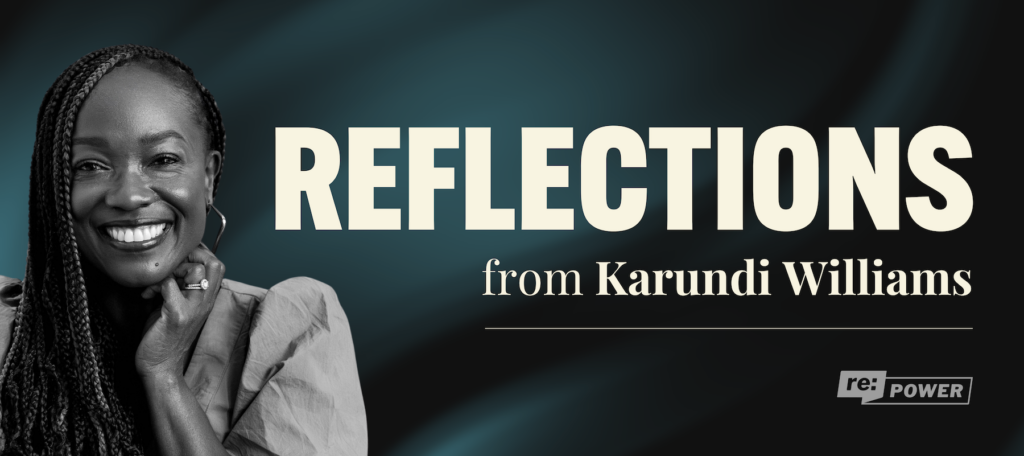
Welcome to the first edition of the Reflections from Karundi newsletter. I’m excited to have this space to connect with you more regularly and share some of what I’m thinking about, wrestling with, learning, and unlearning as a leader.


Lately, I’ve been thinking a lot about fear and how much it has shaped my leadership.

For a long time, I carried a fear of failing, of proving someone’s doubts about me right, and of what my failure might mean for other leaders from marginalized communities, especially Black women. I felt like I always had to have the answer.

And if I’m being real, that fear pushed me to work in ways that weren’t always good for me or the kind of leadership I wanted to model for my team. I said yes when I should’ve said no. I got on planes when I was sick and pushed myself past my limits because I thought that was what leadership required.

Earlier this year, my therapist asked me a question I haven’t been able to shake: Why do you feel like you have to sacrifice yourself?

Whew.

That question opened something up for me. I realized I actually don’t have anything to prove anymore. I deserve to be in this leadership position. I have the lived experience, the expertise, and the track record. So why was I still putting all of this pressure on myself to prove that I belonged?

Well, we know why. Black women are constantly asked to prove that we belong in leadership, that we’re capable, that we know what we’re doing. As Black women leaders, so many of us know what it feels like to have our competence questioned and carry the pressure to prove we belong in the room and know what we’re doing. That’s part of how white supremacy works. It doesn’t just question us from the outside. It teaches us to internalize that scrutiny, to look for our own shortcomings, and to question ourselves before anyone else gets the chance. Somewhere along the way, I internalized that scrutiny and started policing myself. I had to get that police officer out of my own head.

Once I started letting go of that pressure, I began walking into rooms differently. I didn’t need to demonstrate my value by having the perfect answer. I could be curious and ask better questions. I realized that not knowing wasn’t a deficit in my leadership; it could create room for other people, other ideas, and possibilities I might not have considered if I’d focused only on proving I already knew the answer.

That’s made me much more comfortable saying three words that leaders are often afraid to say: I don’t know.

Because the truth is, none of us really knows exactly what comes next, and that kind of uncertainty can be scary, especially when the stakes feel as high as they do right now. Fear can make us want to rush toward certainty, to find the answer, and do anything that makes us feel like we have control. As I learn that uncertainty doesn’t have to push us toward fear, I want to be clear. There are very real reasons to be afraid right now. 

Authoritarianism is here, and we are watching hard-fought gains for our people and our communities being systematically eroded. Families are living in fear as ICE tears people away from their communities. Trans people are facing continued violence simply for being who they are. And Black people are being found hanging from trees across the country, including two cases in Mississippi and North Carolina this month alone. For Black people in this country, it is impossible to see that happening without understanding the history and fear it carries with it.

So when I talk about leading from curiosity instead of fear, I’m not suggesting that we ignore what is happening around us or pretend we aren’t afraid.

The question I’m wrestling with is how do we acknowledge that fear without allowing it to govern how we lead.

Even in the middle of crisis, we have to create enough space to ask what this moment actually requires of us and what becomes possible when we get curious together. We can learn from our history, but none of us has a perfect playbook for this moment. If we stay rooted only in fear, I don’t think we’ll get to the kind of collective action and community we need, not only to make it through this moment, but to build toward the multiracial democracy we want on the other side of it.

I’ve been thinking about that for re:power, too.

We knew our work needed to evolve to meet this moment, but we didn’t need to have all the answers right away. Over the past year, re:power reflected on what we’ve learned from years of training and supporting organizers across the country, asked hard questions about our role, and listened to what our people need from us now.

The more we listened, the clearer our role became. Authoritarianism thrives on fear, isolation, disconnection, and the belief that we are powerless to change our circumstances. We fight that by building the opposite. We invest in leaders, strengthen relationships, and listen to what people tell us they need to build power in their own communities and stay in the fight for the long haul. Because at the end of the day, we are in the people business.

What we learned led us to a new strategy for re:power’s work, which we’ll share more about soon.

In some ways, re:power and I have been evolving together. I’ve stopped believing that leadership requires immediate certainty, and we’ve stopped expecting that of ourselves as an organization, too. Sometimes it means being willing to say, “I don’t know yet.  Let’s figure this out together.”

I look forward to sharing more with you in the months ahead about what I’m learning, what I’m questioning, and where all of this is taking us. More soon.

Stay curious,

Karundi
Filed Under: From Karundi Tagged With: leadership, newsletter, reflections-from-karundi

5 in 5: Five Reflections on Leading a Movement Building Organization for Five Years

June 21, 2024

This month as I celebrate my 5-year anniversary as the Executive Director of re:power, I’m reflecting on what I’ve learned leading a national movement building organization. When I joined re:power, it was not only a first for the organization to have a Black woman leader, but also a first for me—my first time becoming an Executive Director. I did a lot in those first two years to learn from my peers and mentors, stretch myself to grow, and find balance in this work.

Here are just five of my reflections that I hope will encourage others, especially my fellow women of color, stepping into their leadership.

1. Ground Through Purpose During Times of Crisis

When I stepped into the Executive Director role with re:power in 2019, it was a significant milestone for me and I was ready to embrace my leadership. Just as we began to reimagine our potential, the compounded trauma of 2020 hit, testing our resilience. Leading an organization through a pandemic while grappling with the personal and collective trauma of systemic racism was daunting, but we pivoted quickly to train over 2000 organizers online and form transformational partnerships with multiple foundations in that year alone. The mission of re:power and my purpose were crystallized during the pandemic, as the challenges underscored the critical need for unlocking the agency of historically oppressed communities and fostering adaptive leadership.

2. To Push Funders, Push Through Fear

Despite initial insecurities about fundraising, I led re:power to grow from a $3.1 million to a $6 million annual budget and rebuilt our reserve accounts. I challenged philanthropy and our movement to go beyond mere anti-racism rhetoric and put it into practice. This purpose became the driving force behind our actions as an organization. I learned that sharing a clear vision with funders and conveying the necessity of investing in re:power garnered their belief and support. 

3. Make an Inclusive Staff Culture Your “BAE”

Strategy is no good without a strong culture. My fellow senior leaders of color, and I, transformed a burnt-out staff with eroded trust into a values-grounded team. We addressed behaviors, policies, and practices misaligned with our vision, fostering a culture where staff, especially those most marginalized, could be their authentic selves with mutual accountability to our shared values. One staff member noted how my unapologetic leadership as a mother inspired them to reconsider their fears about parenthood. We grew from 11 staff members in 2020 and will soon be 25 by the end of this year. We continue to achieve our best work ever due to our strong staff culture. This internal work is essential to an organization’s success. Staff culture can’t be an afterthought, it must be BAE – before anything else. 

4. Innovate How to Approach Strategic Visioning 

The excessive focus on organizations having a strategic plan is a symptom of the non-profit industrial complex. Leaders must make highly strategic decisions to propel their organizations forward, even without a formal plan. For instance, the support and intentionality I aspired to create for women of color at re:power led to the development of new programming like the Women of Color Leadership Cohort, which supports 30-35 leaders annually across two cohorts. That’s why, for our strategic planning process to be more than a box we checked, it was essential to create an engaging process that involved our staff and board in creating a new strategic vision and brand identity. Our strategic planning process provided us with exceptional clarity, and thanks to our innovative approach and brilliant team, we ensured continuous progress and alignment.

5. Strive for Your Successor to Lead in Abundance

I am committed to building an organization where the next re:power leader of color will inherit an organization built on strength and purpose, allowing them to lead with abundance rather than focus on mere survival. To do this, I equip, mentor, and coach my executive team—entirely women of color—to be fully prepared to step into my role when the time comes. While many talk about building a strong team, few truly invest in preparing their successors for leadership. Too often, leaders cling to power instead of fostering the growth of those around them. I take the opposite approach. I prioritize succession planning with a high level of intentionality, focusing on developing leaders within my organization to ensure sustained success and impact. Our movement’s future depends on embracing this approach wholeheartedly.

Filed Under: From Karundi

Statement on the overturning of Roe v. Wade

July 1, 2022

Today, the Supreme Court of the United States (SCOTUS) overturned the 1973 decision of Roe v. Wade, the decision which protected the right to abortion in this country. Justice Alito makes it clear what he hopes to do with this decision—to reset our country, back to a time that is aligned with the “history and traditions” of our nation. In fact, in multiple places throughout his opinion, Justice Alito refers to this notion. He says that in determining today’s ruling, the Court asked itself “whether the right [to abortion] is ‘deeply rooted in [our] history and tradition’ and whether it is essential to our Nation’s ‘scheme of ordered liberty.’” 

Why am I focused on Justice Alito’s insistence that we adhere to the traditions and history of our nation? Because what Justice Alito is really saying is that he, and many others who want to deny our bodily autonomy, are seeking a country in which white supremacy and patriarchy remain intact. A country in which control of our bodies is not our own. The same country that supported the enslavement and torture of Black bodies.

What we know is that the history and traditions of this country are racist and sexist. We know that the history and traditions of this country limited the liberties and freedom of anyone who was not a white cis-male. And we know that this country and its “democracy” were built to give order to the systems of white supremacy and patriarchy—it is this same “scheme of ordered liberty” which Alito argues does not protect the right to abortion. 

Today’s decision was not a surprise—we knew this was the goal. It feels scary and bad. So, so bad—especially for women of color, non-binary and gender non-conforming people of color, poor people, and anyone who lives at the intersections of marginalization based on race, gender, sexuality, and class. The impact of losing the right to abortion is directly related to losing our rights to bodily autonomy and losing access to so many supports, like compassionate healthcare, that allow us to live full and free lives. 

But I also know that for people like me who live at the intersections of race and gender—Black women and other women of color, Indigenous and Native women, trans and non-binary people of color—our rights have never felt secure in this country. Even when we see progress, we immediately hear the distant roar of those who are coming to take it away. And I’m certain that more attacks on our rights are on their way, as illustrated by Justice Thomas’ reference to the Griswold, Lawrence, and Obergefell decisions. 

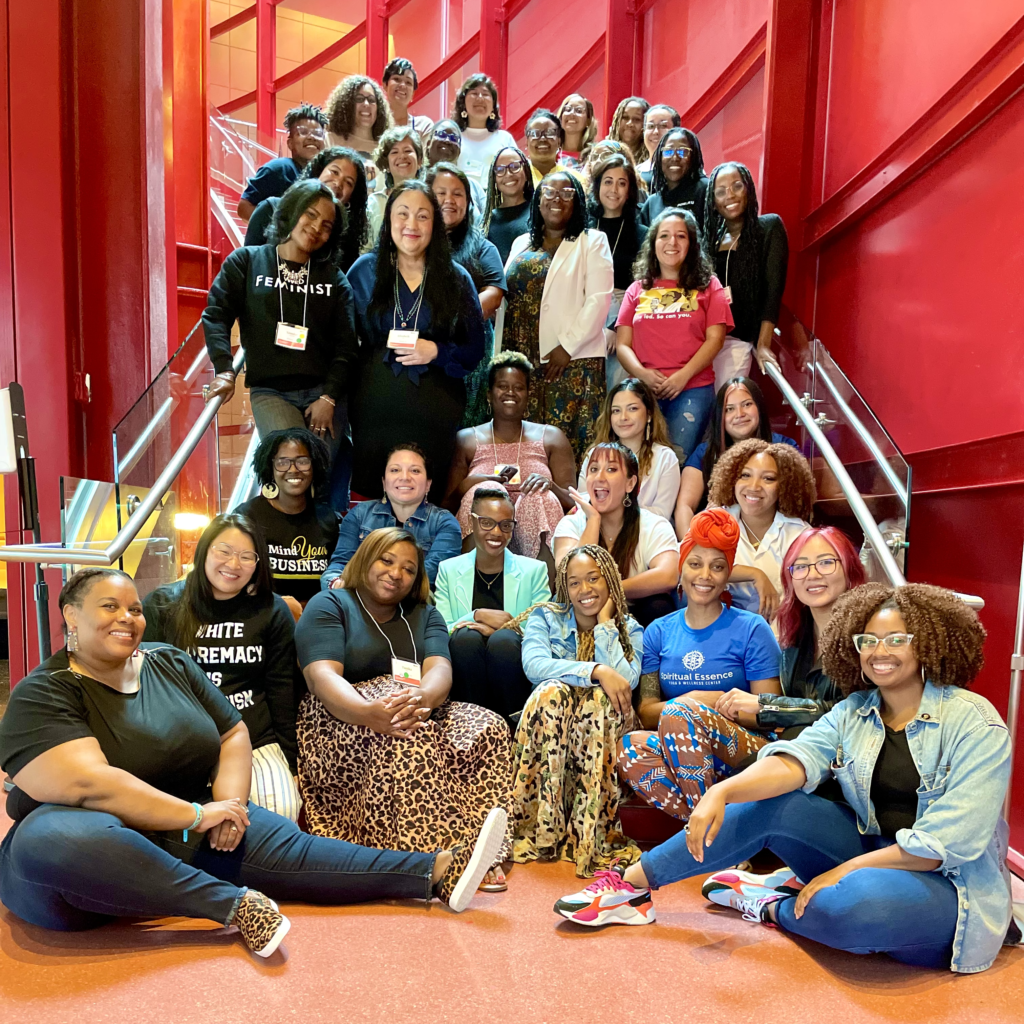
I started my morning not thinking about SCOTUS, but instead reflecting on an incredible thing that happened this week: our first Women of Color Leadership cohort in-person kick-off in Baltimore, MD. 32 incredible women of color leaders came together to begin a journey in which they will deepen their leadership, their understanding of themselves and of each other. All of these women work daily in service of their communities. They are our future leaders. They are my seeds of hope.

Women of Color Leadership Cohort, Baltimore, MD

Today’s decision placed an ominous gray cloud over all of us. We must seek out the rays of sunshine that break through the clouds and stand in that warmth whenever we can. 

I won’t deny that the fight ahead of us will be hard, but we’ve been in this fight for longer than we think. Our ancestors were fighting this fight and our descendants may have to continue it. And in that timeline, there is still so much that we can accomplish together.

Filed Under: From Karundi, News & Statements

Statement on Amir Locke

February 23, 2022

To our re:power community, 

It’s taken some time for me to weigh in on this because we don’t want to be another organization using tragedy to promote our work or to rile people up. And we don’t want to add to the trauma.

But as hard as I tried to not say anything, I’ve been moved to speak. Because the injustices Black people and other communities pushed to the margins continue to face are why re:power exists, they are why I do this work.

A couple of weeks ago, a SWAT team of the Minnesota Police Department quietly entered a home before 7 AM and within seconds murdered 22-year-old Amir Locke. 

I’m not going to spend my time, or yours, detailing the various circumstances that led to Amir’s death. There is enough of that happening in the news/media. From my vantage point, there is no justification for Amir’s killing. I don’t want to engage in the nitpicking of whether Amir had a gun, was it legally purchased, where was it at the time of shooting, etc. I don’t need to get into that, because it’s clear to me, and you, that the system isn’t set up to protect the lives of people like Amir. The lives that were protected last week were the officers. Protected at any cost. Even if the cost is an innocent life, like Amir’s. 

What I want to do is to say that Amir mattered. Amir’s life mattered. And it still matters. Amir’s life was callously and carelessly taken away in a matter of seconds, but that doesn’t mean that we forget him. Amir was an aspiring music artist who had planned to move to Dallas to be closer to his mother. He was 22 years old. 

Amir is not just another statistic, another number, another news story that continues to desensitize us. Amir was a human being. He is survived by his family, his friends, his community… and us. We say his name, just like we continue to say Breonna, George, Tamir, Sandra, Daunte, Eric, Freddie and so many others

I’m doing all I can to center Amir as a person. And as I do that, the question I still sit with is this—why are the people who are hired to protect us, so willing to kill us without regard? The answer I keep coming up with is: they aren’t hired to protect us. At least not me, not Black and Brown people, not my people. 

Black people—we are forced to move through this world with no protection and no safety. We don’t get the opportunity to explain ourselves or justify our actions. Due process just isn’t a part of our reality. Our trials are over before they even start, because the system wasn’t built for us to begin with. 

I don’t have all the answers. Sometimes it is difficult for me to remember what the work I’m doing is in service of, when nothing around me seems to change. Sometimes the unknown of a new system feels overwhelming—what will that be like? It can be scary to try and embark on something new and leave behind something that’s already built. 

But this right here—this doesn’t work. Not for me. And not for you. It doesn’t work for any of us. And I’m tired of this cycle.

So today, I’m remembering Amir and those who were killed that came before him. I’m holding our Black children in my heart, portals of our future. I hope you will take some time to do just that. Continue to tend to your physical and mental health. Replenish your enduring strength. Connect to our ancestors. And recommit yourself to this fight.

We speak your name, Amir. 

With love, 

Karundi

Filed Under: From Karundi, News & Statements

The pain of leading while Black

May 27, 2021

May 25, 2021 marked one year since George Floyd was murdered by the police.

re:power Executive Director Karundi Williams used this solemn occasion to reflect on what Black leadership looks and feels like in a world where Black bodies are constantly under attack. 

“I am trying to create a new reality for people like me — not only in our impact work but also within my organization, and so are many of my fellow executive directors of color across the country. We are all trying to answer an impossible question: How do we lead when faced with the never-ending and persistent trauma we are experiencing in America?“

Read her piece in the Philanthropy News Digest.

Filed Under: From Karundi, In the Media

What is Justice?

April 21, 2021

Yesterday, George Floyd’s murderer was found guilty on all three charges. This verdict confirms what we already knew—that what the world witnessed last summer, as we watched a Black man slowly die at the hands of a White Minneapolis police officer, was murder. But let’s be clear, this is not Justice. 

This guilty verdict is the bare minimum that America owes George Floyd, and this conviction is important. But, the reality is that Chauvin, the officer who murdered George Floyd, is the product of a larger system—a system of policing that was created from its inception to control and harm Black bodies. Chauvin’s actions represent a system working exactly as it was designed. The conviction and sentencing will not bring George Floyd back to us.

Mere moments before the guilty verdict was delivered, Ma’Khia Bryant—a 15-year old Black girl—was shot four times by a police officer in Columbus, OH. She is now another victim of this state-sanctioned violence on Black and Brown bodies across the country. Black folks will be forced to listen to the justifications of this violence, but the reality is another Black person has been erased from existence. 

So what is Justice? Justice is about dismantling the system that allowed this atrocity, and the many others like it, to happen. Justice is reimagining and fundamentally transforming the system that continues to murder its own people. Justice is moving beyond holding an individual accountable to ensuring that the system that breeds and shields murderers is held accountable. Justice is a due process under the law, not a system where police decide to be judge, jury and executioner. It must be a re-envisioning of what it means to protect Black people and other people of color in this country. It must see Black people as those who are worthy of protection and investment, not as those the system is protecting itself against. Justice is bringing an end to the current system of policing in the United States as we know it.

We are proud of the case George Floyd’s legal team assembled and grateful to all of the witnesses who shared their trauma on the stand to ensure this verdict, and to Attorney General Keith Ellison for filing these charges against an Officer. And we’re left wondering, what is it going to take?  

It’s been almost one year since George Floyd was murdered, and in that time we have witnessed continued killings of Black and Brown people at the hands of the police. Breonna Taylor, Tony McDade, David McAtee, Rayshard Brooks, Andre Hill, Marvin David Scott III, Duante Wright, and Adam Toledo.  What will it take to see these people as humans deserving of life? What will it take for the state to recognize that their system is flawed and must be changed? 

What will it take for Justice to be served?

Take care of yourselves.

Filed Under: From Karundi, News & Statements

  • Page 1
  • Page 2
  • Go to Next Page »

Footer

Invest in re:power.

Powerful movements need powerful leaders and powerful resources. Invest in our work today.

Looking to update your info?

Update donor info

Amount

  • About
    • About Us
    • Theory of Change
    • People
    • Alumni
    • Support Us
    • Reports & Financials
    • Careers
  • Classroom
    • Overview
    • Trainings & Events
    • Partnerships
    • Collaborative Governance Academy
    • Camp re:power
    • Data x Power
    • State Courts on the Power Map
    • Training Policies
    • Resources
  • Newsroom
  • Contact Us
  • Legal
    • Privacy Policy & Disclaimer
    • State Nonprofit Disclosures
    • Donor Privacy Policy
    • Donation FAQ
    • Site Credits

Follow us

  • Shop
  • Donate

Newsletter Sign up

© 2026 Re:power

We use cookies on our website to give you the most relevant experience by remembering your preferences and repeat visits. By clicking “Accept”, you consent to the use of ALL the cookies.
Do not sell my personal information.
Cookie SettingsAccept
Manage consent

Privacy Overview

This website uses cookies to improve your experience while you navigate through the website. Out of these, the cookies that are categorized as necessary are stored on your browser as they are essential for the working of basic functionalities of the website. We also use third-party cookies that help us analyze and understand how you use this website. These cookies will be stored in your browser only with your consent. You also have the option to opt-out of these cookies. But opting out of some of these cookies may affect your browsing experience.
Necessary
Always Enabled
Necessary cookies are absolutely essential for the website to function properly. These cookies ensure basic functionalities and security features of the website, anonymously.
CookieDurationDescription
cookielawinfo-checkbox-analytics11 monthsThis cookie is set by GDPR Cookie Consent plugin. The cookie is used to store the user consent for the cookies in the category "Analytics".
cookielawinfo-checkbox-functional11 monthsThe cookie is set by GDPR cookie consent to record the user consent for the cookies in the category "Functional".
cookielawinfo-checkbox-necessary11 monthsThis cookie is set by GDPR Cookie Consent plugin. The cookies is used to store the user consent for the cookies in the category "Necessary".
cookielawinfo-checkbox-others11 monthsThis cookie is set by GDPR Cookie Consent plugin. The cookie is used to store the user consent for the cookies in the category "Other.
cookielawinfo-checkbox-performance11 monthsThis cookie is set by GDPR Cookie Consent plugin. The cookie is used to store the user consent for the cookies in the category "Performance".
viewed_cookie_policy11 monthsThe cookie is set by the GDPR Cookie Consent plugin and is used to store whether or not user has consented to the use of cookies. It does not store any personal data.
Functional
Functional cookies help to perform certain functionalities like sharing the content of the website on social media platforms, collect feedbacks, and other third-party features.
Performance
Performance cookies are used to understand and analyze the key performance indexes of the website which helps in delivering a better user experience for the visitors.
Analytics
Analytical cookies are used to understand how visitors interact with the website. These cookies help provide information on metrics the number of visitors, bounce rate, traffic source, etc.
Advertisement
Advertisement cookies are used to provide visitors with relevant ads and marketing campaigns. These cookies track visitors across websites and collect information to provide customized ads.
Others
Other uncategorized cookies are those that are being analyzed and have not been classified into a category as yet.
SAVE & ACCEPT